




Problem
Goal
My role
2. User Research
Selected Interview Questions
– How do you usually decide what to do in your free time?
– Where do you look for events and activities nearby?
– What information helps you decide whether an event is worth attending?
– What makes you hesitate before visiting an unfamiliar place or attending an event?
– Have you ever wanted to attend an event but had nobody to go with? What did you do?
– How do you decide whether a place or event is right for you?
– Have you ever organized an activity yourself? How did you invite people?
– What would make you comfortable joining an event with people you don't know?
Research Findings
People are more likely to look for activities after seeing an appealing offer or receiving a recommendation from a friend or influencer
Users value real photos and recommendations from other people over polished marketing content.
When filters fail to narrow down the options, users can become frustrated and give up searching.
Some people would like to attend events but hesitate when they don't have anyone to go with.
A map view helps users discover nearby places and understand where activities take place, particularly when travelling by car.
Job Stories


3. Competitor Analysis
Products & References Reviewed
Direct competitor
KudaGo

KudaGo is a city guide for discovering events and places. It helps users explore local activities through event listings, recommendations, and editorial content.
Direct competitor
Kaver

Kaver is an event discovery app with a social component. It combines activity recommendations with the ability to find people to attend events with.
Direct competitor
Afisha

Afisha is an entertainment guide focused on cultural events and activities. It combines event listings and recommendations with ticket purchasing, helping users go from discovering an event to getting a ticket.
Conclusion
Personalized recommendations, news, and stories give users different ways to discover events and activities, beyond browsing event listings alone.
Kaver connects event discovery with finding people to attend events with. This approach addresses not only what users can do, but also who they can do it with.
Afisha lets users move from discovering an event to purchasing a ticket within the same service, connecting browsing with the next step.
All three competitors support map-based discovery, making location a common part of the experience when exploring events and places.
4. Hypotheses
Hypothesis
If users can access personalized recommendations based on their browsing history and preferences, alongside flexible filters, they will find relevant activities and places more easily.
metric
Search success rate, measured by the percentage of search sessions that lead to an event or place detail view.
Hypothesis
If event organizers, place owners, and users are encouraged to share their own photos and personal recommendations, other users will have more context to evaluate activities and decide whether they are worth attending.
metric
Event detail page-to-primary CTA conversion rate, comparing versions with and without authentic photos and personal recommendations.
Hypothesis
If users can explore events and places on a map, they will be better able to compare locations, assess travel distances, and choose activities that fit their plans, especially when travelling by car.
metric
Map-to-detail-view conversion rate, measuring the percentage of map users who open an event or place page.
Hypothesis
If users can create and publish their own activities, Lazy can offer events that reflect the interests of its community, including activities that might not otherwise appear on the platform.
metric
Number of user-created events published per month.
Hypothesis
If users can discover events and purchase tickets within Lazy, they will be more likely to complete their decision to attend.
metric
Checkout completion rate, measured as the percentage of users who start checkout and successfully purchase a ticket.
4.User Flows
5. User Flows
Based on the research insights and product hypotheses, I mapped the main user journeys to define how users could discover events and places, connect with others, and organize activities in Lazy.
Event Discovery FLOW
This flow solves the lack of all-in-one functionality by integrating browsing and ticket purchasing. The ability to view results on a map also helps users with cars plan their trips.
– Context-aware filters: mood, time, price, distance, and more
– Trusted visuals and user-generated reviews
– Integrated ticket purchase - no redirects
Place Discovery FLOW
This flow supports spontaneous exploration without needing to attend scheduled events.
– Designed for unplanned, local exploration
– Filters by vibe: “quiet”, “crowded”, “romantic”
– Real photos and insights from real people
Joining an Event
with Others FLOW
This flow helps users find people interested in the same event. By appearing in the attendee list and connecting through private messages, users can make plans together before the event.
– Opt-in visibility in the attendee list
– Discovering people interested in the same event
– Private messaging to coordinate plans
Event Creation FLOW
This flow addresses the lack of user-hosted events in other services and helps users create social opportunities themselves.
– Minimal form with smart defaults
– Real-time preview and easy editing
– Light moderation to maintain quality and trust
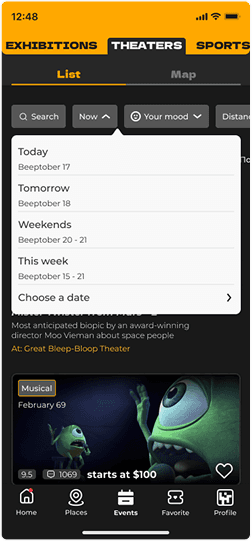
Context-Aware Filtering
Problem:
Users were overwhelmed by long, generic lists.
Solution:
i've decided to use advanced filters (mood, time, price, category, etc) upfront to narrow down results early.
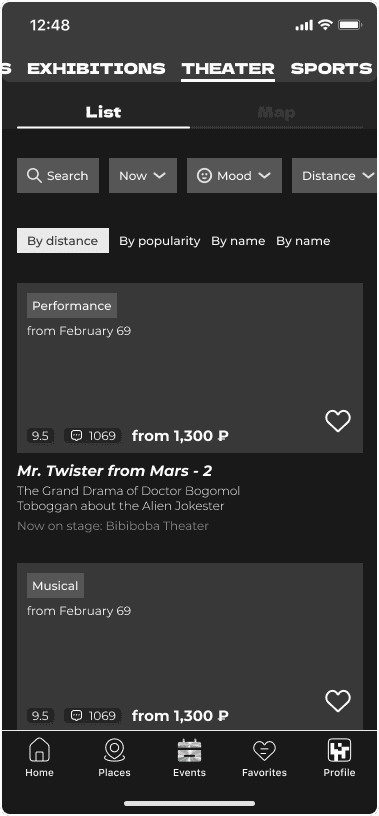


Two Browsing Modes: List or Map
Problem:
Some users plan spatially (e.g. “what’s near me”), others want quick scanning.
Solution:
A toggle between list and map lets users switch modes instantly.
Effortless
Event Creation
Problem:
Creating events felt bureaucratic in other apps.
Solution:
A simple form with live preview and light moderation made publishing easy and fast.


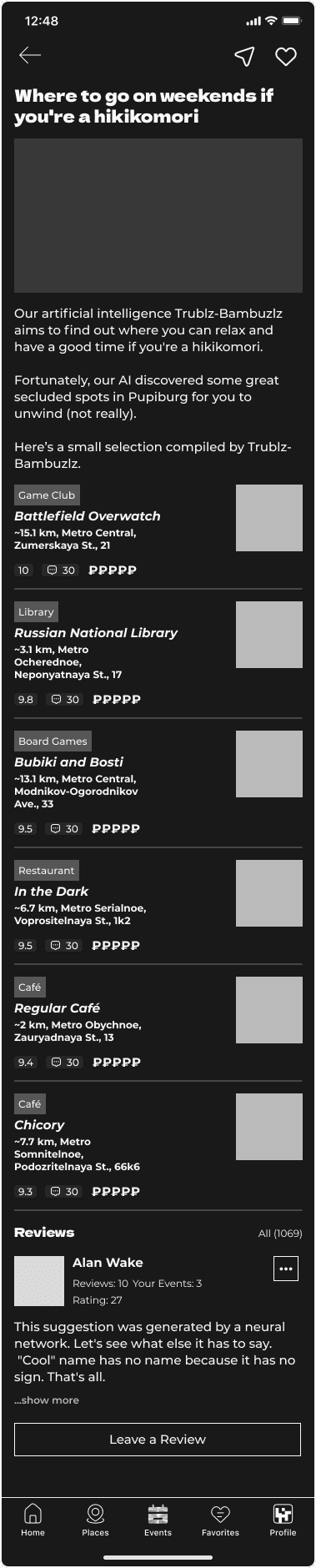
Personalized Collections
Problem:
People don’t want to scroll forever — they want tailored ideas.
Solution:
i've made personalized collections like “Tonight near you” or “Events for introverts”.
Take a closer look
at the selected wireframes


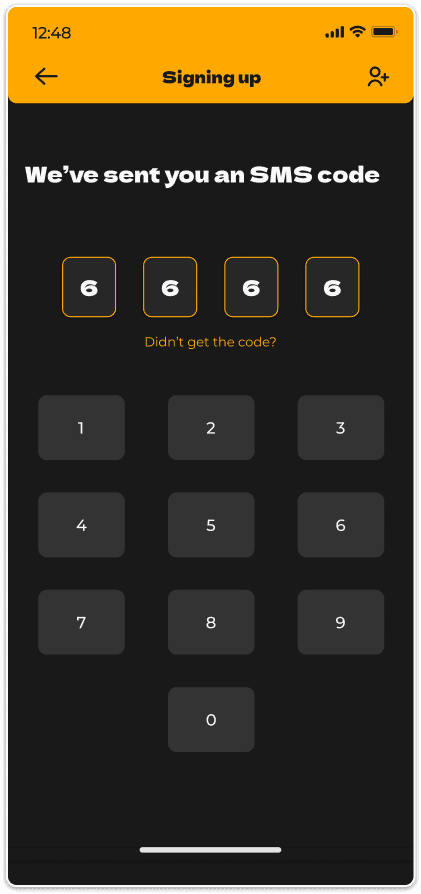
Onboarding & Signing Up
A playful onboarding flow helps users understand the app’s tone and purpose.
After that, a short sign-up process sets up personalized recommendations.




Home & Discovery
Whether users want to explore manually or just see
what’s trending — the home screen gives both.
Contextual filters, map/list view, and personalized Collections included.
HOME SCREEN is the centre of operations. You can start looking for events or places via searching, personal collections, top-picks, and even stories.


filters, and real visuals make it easy to find something fun — right now, nearby. Whether it in a list view or on a map.

Event Card
A detailed yet digestible screen with everything users want to know:
location, time, price, reviews, and vibe.
And a godd way to find a person to go with.


Creating Your Own Event
A short, visual form lets users create events in minutes.
Pick a date, location, assign a price
if needed, and upload a photo — and immediately see
how it will look before publishing.


Messaging other users
Messenger functionality - how else would you try to contact other people
who attend to the same event as you?
Users can send direct messages to each other to coordinate plans, ask event-related questions, or just connect.
This is enabling lightweight social interaction without leaving the app.


8. CONCLUSION

Lazy Brings Event Discovery, Local Places, and Social Interaction Together in One Mobile Experience.
Discover events and places through personalized recommendations, flexible filters, and map-based browsing.
Explore events created by users and discover people interested in attending the same activities.
View event details, save activities for later, purchase tickets, and connect with other users through private messaging.