Problem
Goal
My role
Key Outcomes
Less review time for longer examinations and significantly faster medical protocol preparation.
Examination media, findings, protocols, patient records, and history stay connected within AIIRISDX.
AI highlighted suspected abnormalities and captured findings as part of the clinical workflow.

2. User Research
Selected Interview Questions
– How does a typical endoscopy examination work from start to finish?
– What happens after the examination is completed?
– How do you prepare the medical report?
– Which parts of your workflow take the most time?
– What difficulties do you face during the examination itself?
– How do you review previous examinations or return to important findings later?
– How are photos and video transferred, stored, and accessed after an examination?
– What tools or systems do you currently use to help analyze examination data?
Research Findings
Fatigue, time pressure, and experience can affect what doctors notice during an exam.
Photos and video often need to be transferred to another device before they can be reviewed.
Reporting can take longer than the exam because doctors re-review materials, enter data manually, and attach images.
Different formats and terminology make reports from other doctors and clinics harder to interpret and compare.
Doctors rely on their own clinical judgment and need to stay in control of the final interpretation.
Job Stories
3. Competitor
& Cross-Industry Analysis
Products & References Reviewed
Access to AI endoscopy products is limited to hospitals with dedicated equipment, so GI Genius and CAD EYE were reviewed through publicly available materials.
Direct competitor

An AI-assisted endoscopy system that analyzes the procedure in real time and highlights suspected lesions.
Direct competitor
Fujifilm CAD EYE

An AI-assisted endoscopy system that supports real-time detection and characterization of suspicious areas during an examination.
Video editing
VEED.io
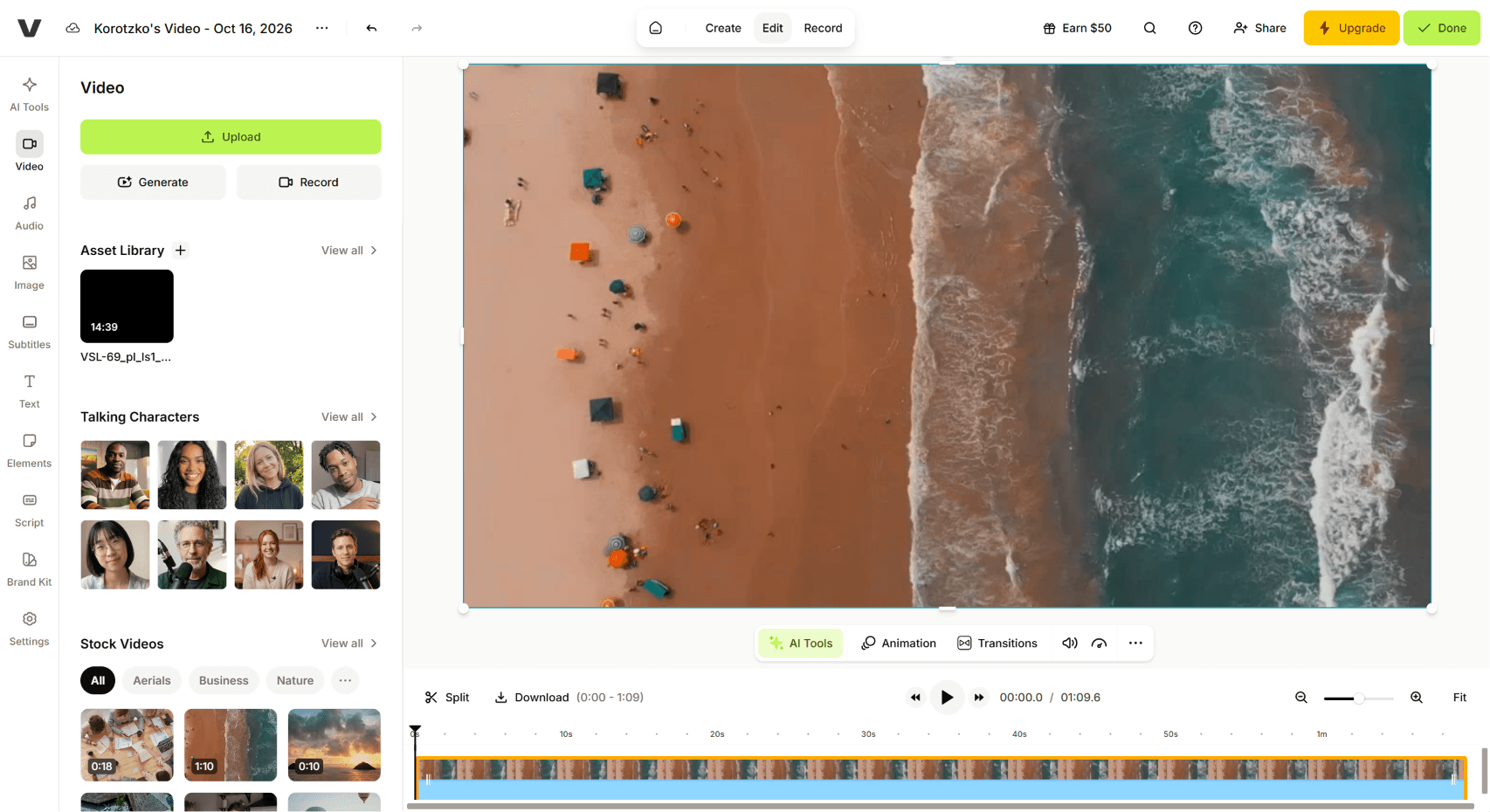
A browser-based video editor that combines a simplified timeline, playback controls, and a media sidebar in one workspace.
Video editing
Adobe Premiere Pro

Professional video editing tools designed for precise navigation and work with long recordings.
Healthcare software
Medical systems

Systems used to manage patient information, medical history, examinations, and clinical records.
Cross-industry
B2B SaaS products

Web applications that organize complex workflows, multiple product areas, and large amounts of information.
Conclusion
Lightweight video products showed that users can navigate long recordings without the dense controls of professional editing software.
They make it possible to structure a continuous video around specific moments and return to them without searching through the recording again.
In medical systems, individual examinations and results are typically organized within the patient's history rather than treated as separate records.
Complex B2B products rely on established navigation and control conventions instead of introducing custom interaction models for every task.
4. Hypotheses
AI-assisted detection was part of the product concept from the beginning. The research helped identify two additional areas where the product could reduce doctors' workload: examination review and medical reporting.
Hypothesis
Adding a timeline with markers for detected findings could help doctors jump directly to relevant moments instead of reviewing the entire recording, reducing review time.
metric
Time required to review the examination recording.
Hypothesis
Automatically creating a medical protocol from patient data and examination findings using AI could significantly reduce the time doctors spend preparing the report.
metric
Time required to complete the medical report.
Challenge we faced
The original idea was to generate the entire medical protocol automatically with AI. Later in the project, while preparing the MVP, it became clear that technical implementation
of reliable full protocol generation was much harder than expected.
We had to quickly rethink the concept and reformulate the hypothesis around what could be implemented reliably.
old Hypothesis
Automatically creating a medical protocol from patient data and examination findings using AI could significantly reduce the time doctors spend preparing the report.
metric
Time required to complete the medical report.
new Hypothesis
Using known patient data and examination findings to pre-fill information and suggest contextually relevant protocol fields could reduce reporting time while keeping the final report under the doctor’s control.
metric
Time required to complete the medical report.
User Flows

Key Flow Decisions
Examination setup
The flow supports both live examinations and pre-recorded video. The setup differs, but both paths lead into the same examination and analysis process.
exam and review
When a finding is detected during the examination, its position is saved with the examination media. After the procedure, the doctor can return directly to relevant moments instead of searching through the full recording.
Protocol creation
The protocol starts with information already available from the patient data base records and examination.
Relevant fields are suggested from the recorded findings, while templates and manual input remain available when needed.
Edge Cases
Wrong patient selected
Video signal lost
Interface Design
Examination Preparation
Screen goal
Set up the examination and choose how it will be performed.
What I implemented
Search for existing patients or create new ones
in preparation, without opening
a separate patient-management flow.
Examination
Screen goal
Conduct a gastroenterological examination, inspect the anatomical areas covered by the procedure, identify abnormalities, and capture the snapshots needed for later review and protocol preparation.
What I implemented
AI-assisted detection directly in the video feed, highlighting suspected abnormalities while keeping manual snapshot capture available.
A video timeline with markers for every captured snapshot creating visual anchors that help doctors remember and return to important moments during review.
A snapshot sidebar organized by anatomical area, with abnormalities visually emphasized
A focused full-screen mode that maximizes the video feed when the doctor needs fewer distractions.


Examination Review
Screen goal
Review the completed examination, verify captured findings, add any missing snapshots, and prepare relevant images for the medical protocol.
What I implemented
The full recording and all captured snapshots are available directly in AIIRISDX - no need to manually transfer media to another workstation before review.
Linked timeline and snapshot navigation: markers show where snapshots were captured, and selecting a snapshot jumps the video directly to that moment.
Snapshots can be added during review and attached to the future protocol immediately.
Filtering, sorting, and comments for faster review,
Protocol constructor
Screen goal
Prepare the medical protocol by documenting examination findings, completing the required clinical details, and attaching relevant images.
What I implemented
Context-aware protocol sections based on detected findings: when AI identifies an abnormality, the constructor adds the relevant section, pre-fills the information already known, and reveals additional fields based on the doctor’s input.
Automatic pre-fill of known patient, doctor, clinic, and equipment data, so the doctor does not have to enter the same information manually for every protocol.
Automatic attachment of relevant finding images by AI, with the option for the doctor
to manually add or remove images when needed.
Templates and manual controls for cases where AI suggestions are not enough.


Protocol Review & Edit
Screen goal
Review the completed medical protocol, make any necessary corrections, and finalize the examination.
What I implemented
Full manual control over the final protocol, including editing text and adding or removing snapshots, based on interview feedback that doctors need to retain control over the final clinical document.
A4-format document preview that reflects how the final printed protocol will look.
A minimal editing toolbar with finalization actions on the same screen, including saving the protocol, PDF or DICOM export, printing, and completing the examination.


Additional Product Areas
Beyond the main examination flow, I also designed the core interfaces for patient management, examination history, and everyday navigation across AIIRISDX.
Patient Management
To help doctors find and review patient records, I designed a searchable patient list and patient profiles with key information and access to previous examinations.


Examination History
To make previous examinations easier to find and review, I designed a searchable history with filters and date selection for quickly accessing past examination records.


Dashboard
To give doctors a clear starting point, I designed a dashboard with quick access to recent examinations, patients, and the main product actions.
UI Kit
I built a custom UI kit for AIIRISDX with reusable components, component states, design tokens, and shared interaction patterns to keep the product consistent and easier to scale.

Examination Review
Result: 50–75% less time for longer examinations
Hypothesis #1
Adding a timeline with markers for detected findings could help doctors jump directly to relevant moments instead of reviewing the entire recording, reducing review time.
metric
Time required to review the examination recording.
The effect was most noticeable in longer examinations, such as colonoscopies.
The timeline with markers reduced review time by approximately 50–75%. For shorter examinations, the difference was smaller because the recordings were already relatively quick to review.
Medical Protocol Preparation
Result: 15–20 min → 3–5 min to complete a protocol
Hypothesis #2
Using known patient data and examination findings to pre-fill information and suggest contextually relevant protocol fields could reduce reporting time while keeping the final report under the doctor’s control.
metric
Time required to complete the medical report.
AI-assisted protocol preparation, including automatic data pre-fill, context-aware protocol sections, and automatic attachment of relevant images, reduced medical protocol preparation time from approximately 15–20 minutes to 3–5 minutes.
8. CONCLUSION
AIIRISDX was designed from scratch as a single platform for AI-assisted examination, review, medical reporting, patient management, and examination history.
Key Outcomes
Less review time for longer examinations and significantly faster medical protocol preparation.
Examination media, findings, protocols, patient records, and history stay connected within AIIRISDX.
AI highlighted suspected abnormalities and captured findings as part of the clinical workflow.